llms.txt validator
Checks against llmstxt.org v2 (August 2026)what changed
Check any site's llms.txt against thellmstxt.orgspec: structure, link health, and the conventions that aren't actually in the spec. Every finding says where its rule comes from, so you can tell a spec violation from a habit.
Reads the llms.txt at the path you give it, walking up to the site root if there is none, then checks the links it lists. Nothing is stored.
Chrome extension
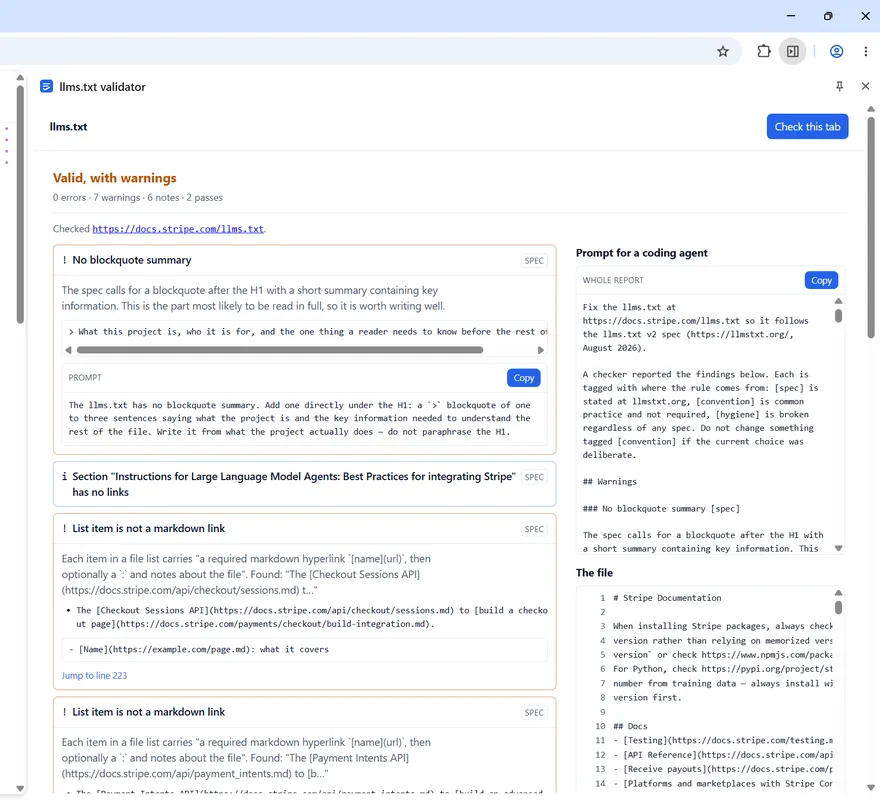
Check the tab you're on
The same rules in a side panel, run against the page in front of you. It reads the v2 link relations out of the document your browser already rendered — the<link> elements and theLink: header — and it reaches hosts this page cannot: a staging site, an intranet address, anything that is not on the open internet.
It does not follow the links inside the file. Checking every link would mean asking for permission to every site those links point to, and it does not ask for that. That job stays here, and the panel links back to this page when a file has links worth checking.
Free. Opens with the toolbar button or Ctrl+ Shift+ Y.
Frequently Asked Questions
What is llms.txt?
A markdown file that tells language models what a site is and where its important content lives, in a form they can read without parsing navigation, scripts and boilerplate out of your HTML. It sits at /llms.txt, or at any subpath such as /docs/llms.txt. It was proposed by Jeremy Howard at llmstxt.org.
What changed in llms.txt v2?
Four things, in August 2026. It recommends two standard link relations so a client can find these files from any page: rel="describedby" points at the llms.txt covering the page, and rel="alternate" type="text/markdown" at that page's markdown version, as an HTML link element or an HTTP Link header. Both URL forms for a markdown version are allowed now, page.html.md and page.md, where v1 had only the first. A file at a subpath has defined meaning: it covers the pages under its path, and the most specific one applies. And the llms_txt2ctx context-expansion tool left the proposal, taking the mechanical meaning of the Optional section with it. That section is now a naming convention and nothing more.
See what changed in v2.
What does the spec actually require?
One thing: an H1 with the project or site name. The spec calls it the only required section. A blockquote summary, content sections and H2 file lists are all described as optional or 'zero or more'. So a missing H1 is the only structural problem this checker calls an error, and everything else is labelled by where the rule comes from.
Is llms-full.txt part of the spec?
No. It appears nowhere in the llmstxt.org spec. It is a widely used convention for a single file with the full content inlined, so a client does not have to follow every link. This checker reports it as a convention, never as a spec violation.
See the spec's full text.
Does having an llms.txt improve my ranking?
There is no evidence that any search engine uses it as a ranking signal, and none of them have said they do. What it does is give a model reading your site a clean, current description you control, instead of one inferred from your markup. Treat it as content hygiene for answer engines, not as an SEO trick.
Do you store the sites I check?
No. The check runs per request and nothing about the target is written down. It requests llms.txt at the path you give it and, if nothing is there, at each directory above it up to the root; then robots.txt, a sibling llms-full.txt, the page the file covers, and a HEAD request per link listed. Every one of those is a public URL.
Want this done properly across your estate?
I work on cloud architecture, DevOps and FinOps — including making systems legible to the agents that now read them.
Book a call